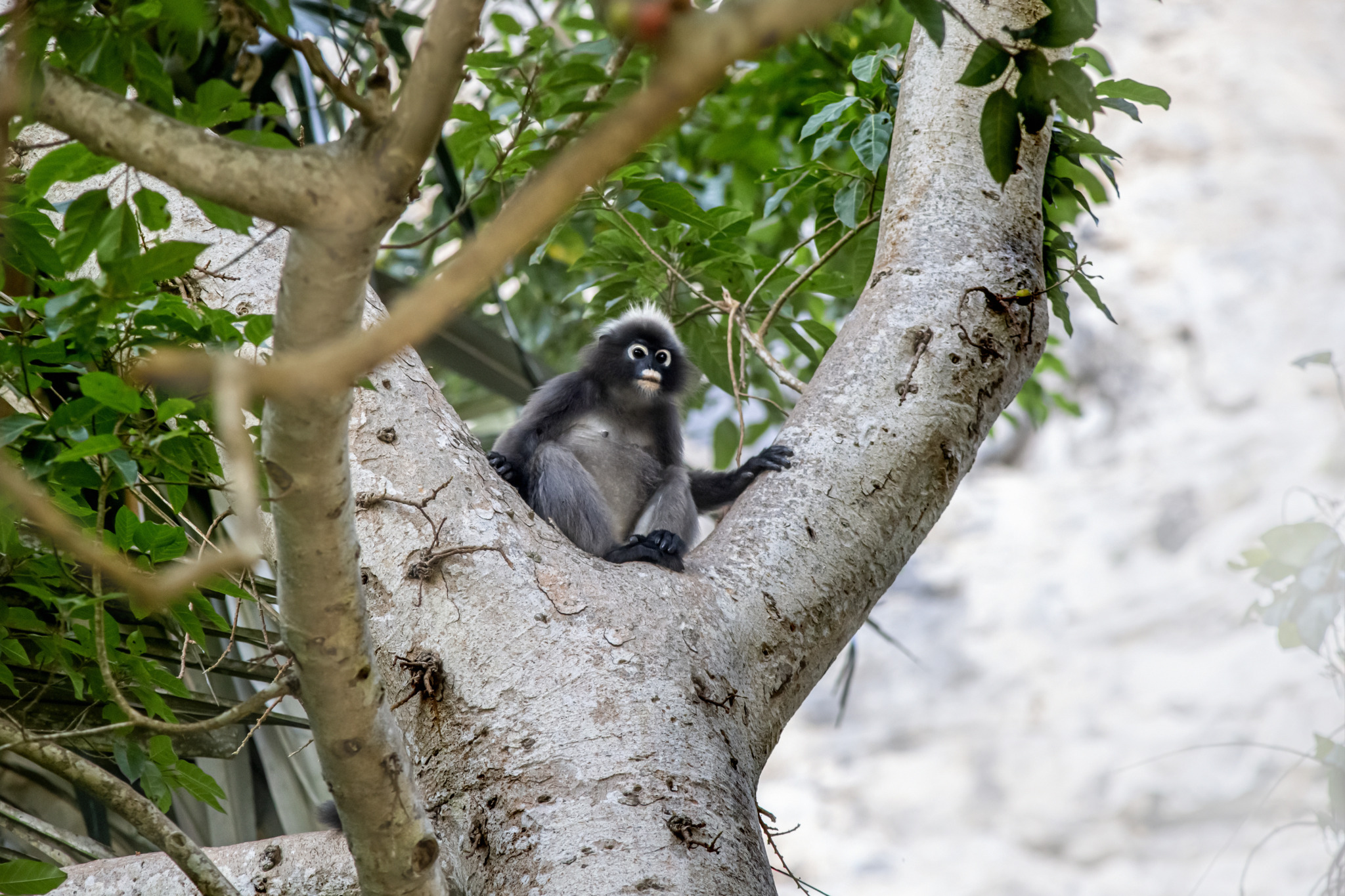

The Dusky Leaf Monkey (Trachypithecus obscurus)—also known as the Spectacled Langur—is perhaps the most “fashionable” primate in the canopy. With their permanent white “monocles” and contrasting pale muzzles, they look less like wild animals and more like a quirky cast of Victorian intellectuals.
Based on the wildlife photography from Southeast Asian expeditions (as seen on karits.eu), here is a look at these soulful leaf-eaters.
1. The “Spectacled” Aesthetic
The most striking feature of the Dusky Leaf Monkey is its facial markings.
- The Monocle: Large, brilliant white rings surround their eyes, set against a face of charcoal-grey skin. This isn’t just for show; it’s thought to help individuals recognize each other in the dappled, high-contrast light of the rainforest canopy.
- The “Goatee”: They also sport a distinct white patch around their mouth and chin, making them look perpetually surprised or deeply thoughtful.
- The Coat: Their fur is a dense, uniform dark grey or black, which makes those white facial features “pop” in photographs.
2. The “Cheeto” Babies
One of the most mind-bending facts about this species is the dramatic color shift from birth to adulthood.
- Vivid Orange: Infants are born a brilliant, neon orange—roughly the color of a Cheeto or a ripe apricot.
- The “Find the Baby” Strategy: Evolution likely chose this color so that the mother and the rest of the troop can easily spot a stray infant in the dense green foliage.
- The Transformation: After about six months, the orange fur begins to fade into grey, starting from the tail and moving toward the head, until they reach their “monocled” adult form.
3. Specialized Leaf-Eaters
Unlike the more opportunistic Macaques (who will happily steal your lunch), Dusky Leaf Monkeys are specialized folivores.
- The Stomach: They have complex, multi-chambered stomachs (similar to cows) that contain specialized bacteria to break down the cellulose and toxins found in leaves.
- The Slow Life: Because leaves are low in energy, these monkeys spend a significant portion of their day sitting quietly and digesting, making them a relatively calm and cooperative subject for patient photographers.
📸 Photographer’s Perspective: Managing the Contrast
Photographing a black monkey with white eye-rings in a dark jungle is a masterclass in dynamic range management.
- Expose for the Eyes: If you let your camera’s auto-exposure take over, it will likely overexpose the black fur into a muddy grey or “blow out” the white eye rings. Use spot metering on the white circles and then adjust to ensure you keep detail in the dark fur.
- The “Dappled Light” Trap: Avoid shooting them in direct sunlight through leaves; the “zebra stripes” of light and shadow will ruin the composition. Look for them in open shade or on “bright overcast” days.
- Capture the Social Bond: These monkeys are very social. The best shots often aren’t single portraits, but images of “allomothering,” where other females in the troop help carry and groom the orange infants.
- Shutter Speed: Even though they sit still to digest, their hands and tails move constantly. Keep your shutter speed at 1/500s or higher to ensure the fine hairs of their “spectacles” remain tack-sharp.
Quick Facts Table
| Feature | Detail |
| Scientific Name | Trachypithecus obscurus |
| Common Names | Dusky Leaf Monkey / Spectacled Langur |
| Status | Endangered (IUCN) due to habitat loss and the pet trade |
| Diet | Primarily young leaves, seeds, and unripened fruit |
| Infant Color | Bright Orange (Transitioning at 6 months) |
| Habitat | Malaysia, Thailand, and Myanmar |
Discover more primate portraits and high-resolution captures of the “Spectacled” residents of the rainforest at karits.eu.
Views: 1651
Subscribe to the newsletter: