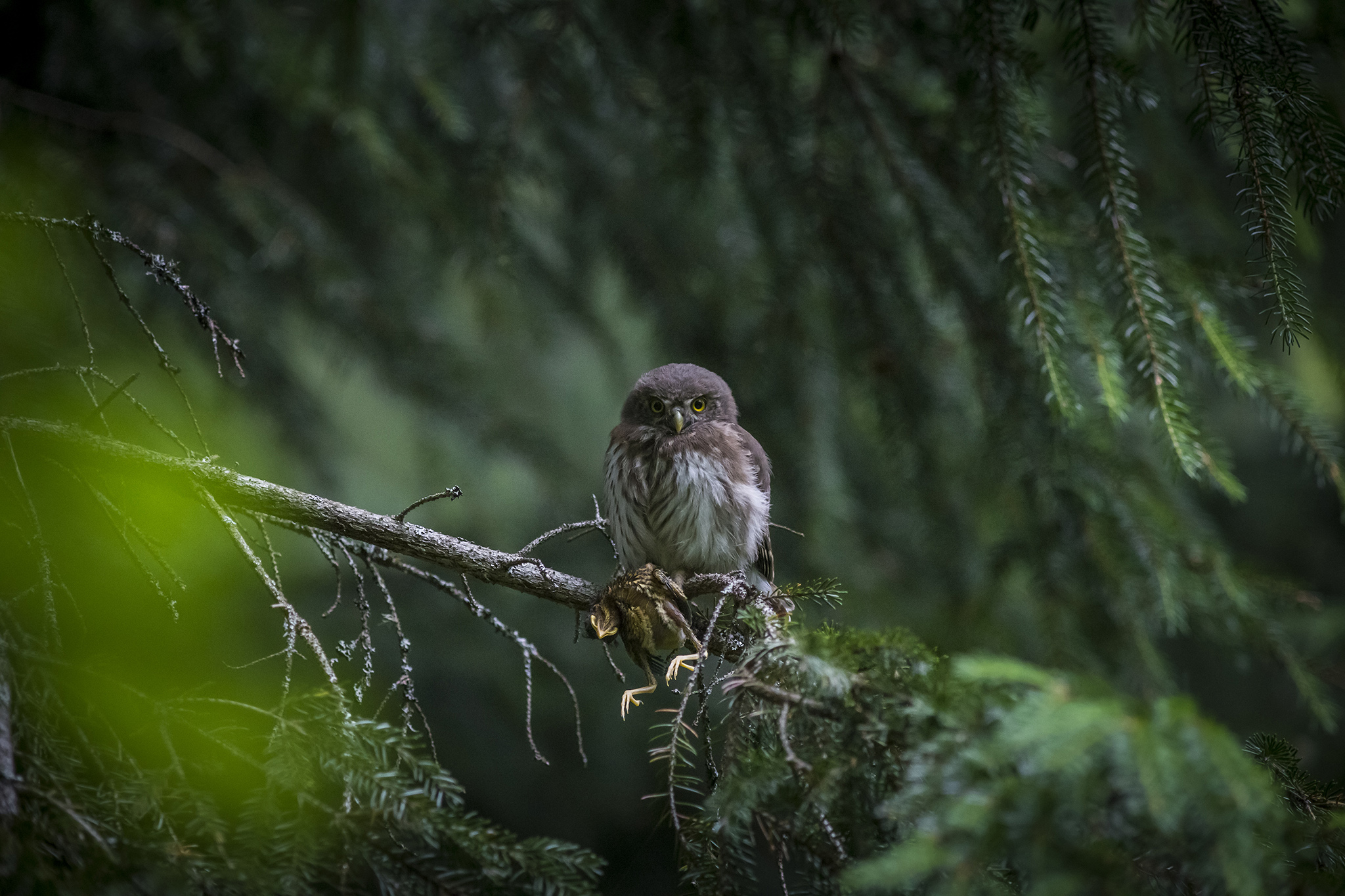

The Eurasian Pygmy Owl (Glaucidium passerinum)—or Värbkakk in Estonian—is a pint-sized powerhouse. Don’t let its adorable, spherical appearance fool you; this is the smallest owl in Europe, yet it possesses the hunting ambition of a Great Horned Owl. It’s essentially a “feathered pocket-rocket” that dominates the coniferous forests of Northern Europe.
As featured in the high-resolution galleries at karits.eu, here is the profile of this elusive miniature predator.
1. The “False Face” (Occipital Eyes)
The Pygmy Owl’s most brilliant survival hack is located on the back of its head.
- The Illusion: It features two dark patches of feathers surrounded by white that perfectly mimic a pair of large, staring eyes.
- The Strategy: This is called an occipital face. It serves to confuse potential predators (like hawks) and “mobbing” songbirds, making them believe the owl is watching them even when its back is turned. This prevents sneak attacks while the owl is busy foraging.
2. The Miniature Predator
Despite being barely larger than a Bullfinch, the Värbkakk is a ferocious hunter.
- The Diet: It specializes in small birds (like tits and finches) and voles. Remarkably, it can take down prey nearly its own size.
- The Larder: During the cold Estonian winters, these owls are known for “caching” food. They kill more than they can eat and stuff the carcasses into old woodpecker holes or nest boxes, creating a frozen pantry. When they get hungry, they sit on the frozen prey to thaw it out with their body heat before eating.
[Image comparing the size of a Eurasian Pygmy Owl to a common starling]
3. Diurnal Activity
Unlike most owls that are strictly “creatures of the night,” the Pygmy Owl is diurnal and crepuscular.
- Daylight Hunter: You are most likely to see them during the day, especially at dawn or dusk.
- The “Pumping” Tail: If you spot one perched on the very tip of a spruce tree, watch its tail. They have a nervous habit of cocking their tails up and down or side to side, which is a tell-tale sign that it’s a Pygmy Owl rather than a knot in the wood.
📸 Photographer’s Perspective: The Needle in the Haystack
Because they are only about 15–19 cm tall, finding them is the hardest part of the process.
- Listen for the Mob: If you hear a frantic, high-pitched “screaming” session from a group of Coal Tits or Goldcrests, follow the sound. They have likely found a Pygmy Owl and are trying to harass it into leaving.
- The Low-Light Challenge: They love the “Blue Hour.” You’ll often be shooting at the limits of your gear’s ISO capabilities. To keep the image clean, try to underexpose slightly to preserve the highlights in the white facial “brows.”
- Focus on the Iris: Their eyes are a piercing, brilliant yellow. Nailing the focus on that yellow ring is what transforms a “bird on a branch” shot into a compelling wildlife portrait.
- Background Compression: Use a long telephoto lens (500mm+) to compress the background. Since they sit in dense spruce forests, a long lens helps turn the messy needles into a soft, creamy green bokeh.
Quick Facts Table
| Feature | Detail |
| Scientific Name | Glaucidium passerinum |
| Estonian Name | Värbkakk |
| Height | 15–19 cm |
| Wingspan | 34–39 cm |
| Weight | 60–80 g |
| Voice | A monotonous, rhythmic “tueet… tueet…” |
| Status | Rare but stable in old-growth forests |
You can view the full 2025/2026 collection of Värbkakk sightings and download CC0-licensed wildlife imagery at karits.eu.
Views: 1653
Subscribe to the newsletter: