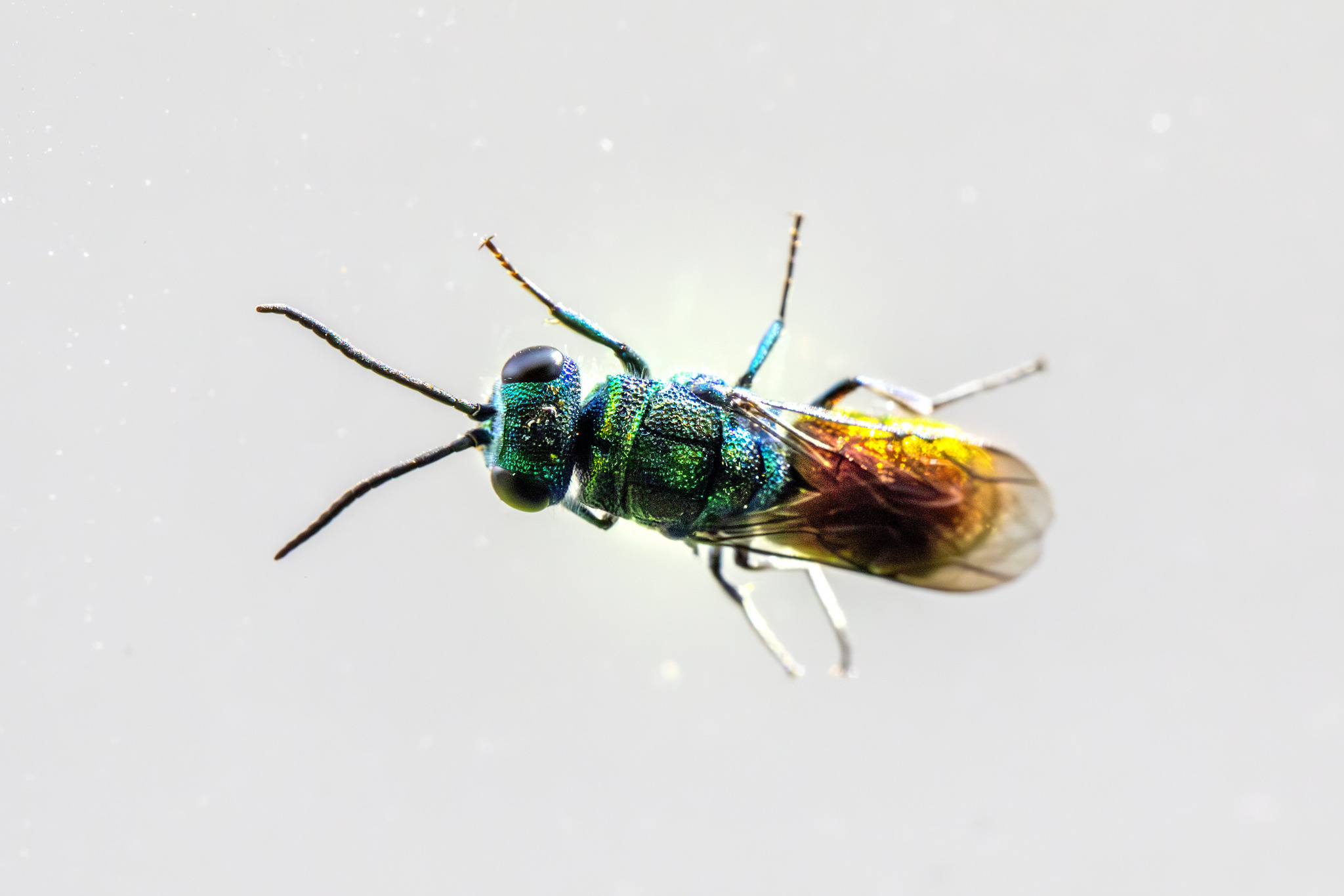
💎 Deep Review: Cuckoo Wasp (Chrysis fulgida)
If nature held a competition for “Most Beautiful Thief,” the Cuckoo wasp would take the gold medal. Member of the Chrysididae family, Chrysis fulgida is often called a Jewel Wasp or Ruby-tailed Wasp. It is a stunning, metallic marvel with a lifestyle that is—true to its name—deceptively parasitic.
📏 Physical Characteristics: The Living Gem
- Iridescent Armor: They are famous for their brilliant, metallic luster. This isn’t just pigment; it’s structural coloration created by the microscopic texture of their exoskeleton reflecting light.
- Color Palette: Chrysis fulgida typically displays a dazzling metallic blue or green head and thorax, contrasted sharply by a fiery ruby-red or purple abdomen.
- The Cuticle (The Tank): Their “skin” is exceptionally thick and deeply pitted. This isn’t just for show; it is heavy-duty armor designed to protect them from the stings and jaws of the host wasps they invade.
- Size: They are relatively small, usually ranging from 7 to 12 mm in length.
- The Abdomen: The underside of the abdomen is concave, which is a key part of their defensive strategy.
🥚 The “Cuckoo” Strategy (Kleptoparasitism)
Just like the Cuckoo bird, this wasp doesn’t build its own nest or provide for its young. It is a kleptoparasite (a “thief parasite”).
- Stalking the Host: Chrysis fulgida typically targets solitary wasps (like mason wasps or potter wasps). It watches and waits for the host to leave its nest (usually in a hollow plant stem or a hole in wood).
- The Home Invasion: While the host is out hunting for caterpillars to feed its own larvae, the Cuckoo wasp slips inside and lays its egg in the host’s nest.
- The Takeover: When the Cuckoo wasp larva hatches, it either eats the host’s egg/larva or simply eats the food supply (the paralyzed insects) provided by the host, effectively starving the rightful inhabitant.
🛡️ Defensive Tactics: The “Ball” Trick
When you spend your life breaking into the homes of other stinging insects, you need a solid defense plan.
- Volvation: If the host returns and catches the Cuckoo wasp in the act, the Cuckoo wasp uses its concave abdomen to roll into a tight, armored ball.
- Immunity to Stings: In this tucked position, its vulnerable undersides and legs are protected. The host wasp can sting and bite the thick, metallic armor of the Cuckoo wasp as much as it wants, but it usually can’t find a way in. Eventually, the frustrated host often just kicks the “ball” out of the nest, allowing the Cuckoo wasp to unroll and fly away unharmed.
🌏 Habitat and Distribution
- Range: Found across much of Europe and temperate Asia.
- Where to find them: They love sun-drenched, vertical surfaces. You’ll often see them scurrying rapidly over old wooden fences, dead trees, stone walls, and “bee hotels.” They move with a restless, jerky motion, their antennae constantly flickering as they “smell” for a potential host’s nest.
🍎 Diet
- Adults: Unlike their predatory larvae, adult Cuckoo wasps are peaceful pollinators. They feed on nectar from flowers like wild carrot, yarrow, and other umbellifers.
- Larvae: As mentioned, they are carnivorous, consuming the eggs, larvae, and stored provisions of their host.
⚠️ Conservation Status
- Status: Generally not listed on global “endangered” lists, but like many specialized insects, they are sensitive to local habitat loss.
- The Ripple Effect: Their survival is directly tied to the health of their host species. If the solitary bees and wasps in an area disappear due to pesticides or lack of nesting sites, the Cuckoo wasp will vanish shortly after.
Fun Fact: Cuckoo wasps cannot sting humans in the traditional sense. While they have an ovipositor (egg-laying tube) that looks like a stinger, it has been modified for egg-laying and lacks the venom-delivery system found in social wasps. They are all “armor” and no “sword.”
Views: 1952
Subscribe to the newsletter: