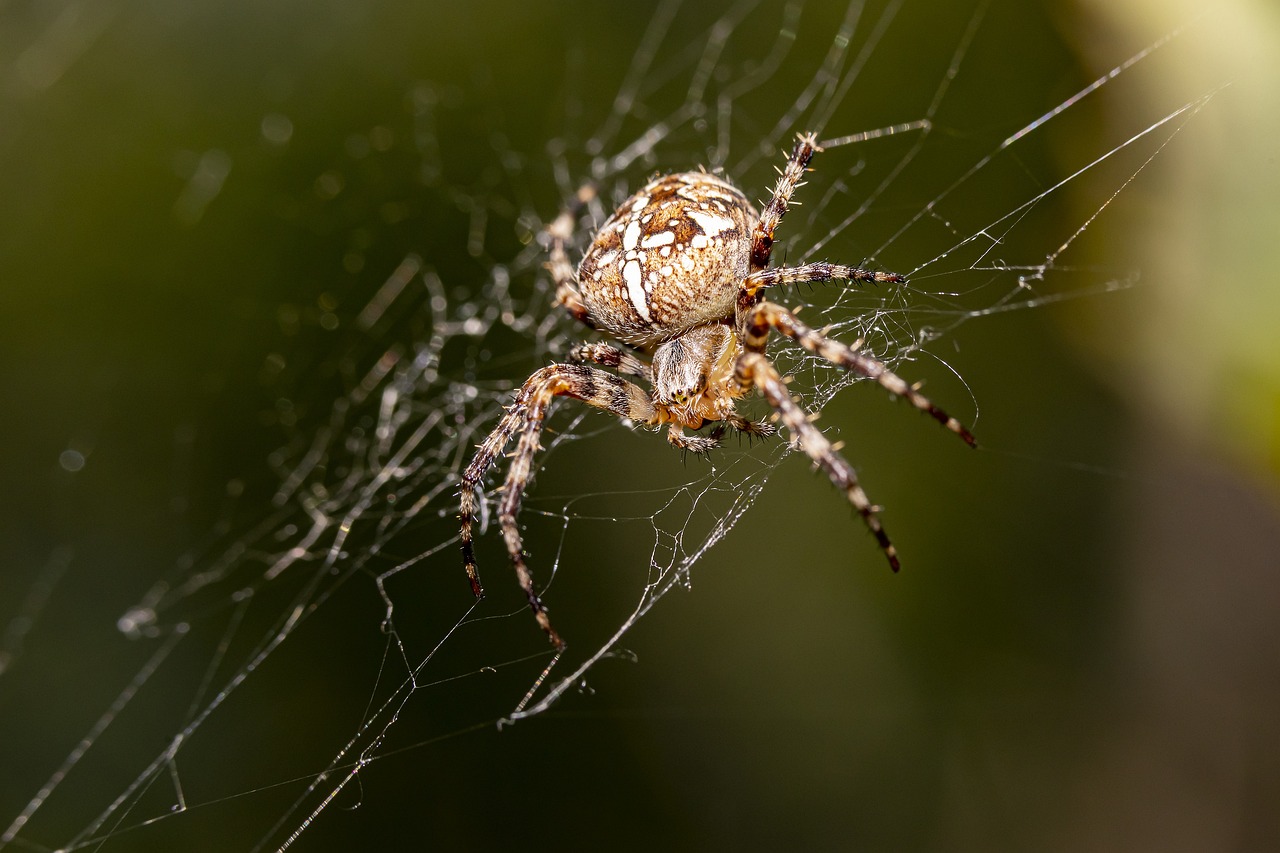
🕷️ Deep Review: European Garden Spider (Araneus diadematus)
The European garden spider, also known as the Cross Spider or Diadem Spider, is the architect of the classic “Halloween” orb web. While they might trigger a bit of arachnophobia in some, they are actually one of the most beneficial and fascinating residents of a healthy garden.
📏 Physical Characteristics
- The Signature Cross: Their most famous feature is the distinctive white cross-shaped pattern on the top of their abdomen. This isn’t just paint; it’s made of cells containing guanine, a byproduct of their metabolism that they repurpose as pigment.
- Variable Colors: Their base color can range wildly from pale yellow or light brown to deep orange or almost black, depending on their environment and diet.
- Hairy Legs: Their legs are covered in sensitive spines and hairs (setae) used to detect minute vibrations in their web.
- Sexual Dimorphism:FeatureFemaleMaleBody Length10–20 mm5–10 mmAbdomenLarge, bulbous, and round.Small, slender, and elongated.Life ExpectancyUntil the first hard frosts.Much shorter (often dies after mating).
🕸️ The Master Architect: The Orb Web
The Garden Spider is a master of geometry. They build a classic, vertical spiral web that is a marvel of biological engineering.
- Daily Rebuild: These spiders are surprisingly industrious. They often rebuild their entire web every single day, usually in the early morning.
- Recycling: To save energy, they often eat their old web to “recycle” the silk proteins before spinning a fresh one.
- The Waiting Game: They typically sit right in the center of the web (the hub), hanging head-down, waiting for a vibration. If they feel too exposed, they retreat to a nearby leaf, holding a “signal line” of silk that vibrates when something hits the web.
🍎 Diet and Hunting
- Pest Control: They are the garden’s primary defense against flying insects. Their diet includes flies, mosquitoes, moths, wasps, and even small butterflies.
- The “Wrap and Bite” Technique: When prey hits the web:
- The spider rushes out, guided by vibration.
- It bites the prey to paralyze it with venom.
- It rapidly wraps the prey in a silk “shroud” to save it for later or eat it immediately.
- Liquefying Food: Like most spiders, they cannot chew. They inject digestive enzymes into the prey to liquefy the insides and then “drink” the resulting soup.
🐣 Life Cycle and the “Yellow Ball”
- Dangerous Dating: Mating is a high-stakes game for the male. He must cautiously approach the female, plucking the web like a guitar to signal he is a mate and not a snack. Even then, he is often eaten after the deed is done.
- Overwintering: The female lays her eggs in a dense, yellowish silk cocoon in autumn and then dies.
- The Hatchlings: In late spring, hundreds of tiny, bright yellow and black spiderlings hatch. They initially stay together in a “golden ball.” If you touch the ball, they “explode” in every direction to confuse you, only to huddle back together once the danger passes.
⚠️ Myths vs. Reality (The Candor Part)
Let’s clear the air for 2026: The European garden spider is not dangerous to humans.
- Do they bite? Very rarely. They are docile and would much rather run away or drop to the ground on a silk line than fight.
- What if they do? If you physically squeeze one, it might bite in self-defense. The sensation is roughly equivalent to a minor pinprick or a mild bee sting, usually resulting in a small red bump that fades quickly.
- The “Flying” Spider: In late summer, you might see them “flying.” This is called ballooning—young spiders release a strand of silk into the wind and are carried miles away to find new territories.
Pro-Tip: If you see a web across your path, try to walk around it. It took that spider hours of work and a lot of protein to build. If you must move it, use a stick to gently relocate the anchor lines—the spider will likely just rebuild nearby.
Views: 1570
Subscribe to the newsletter: