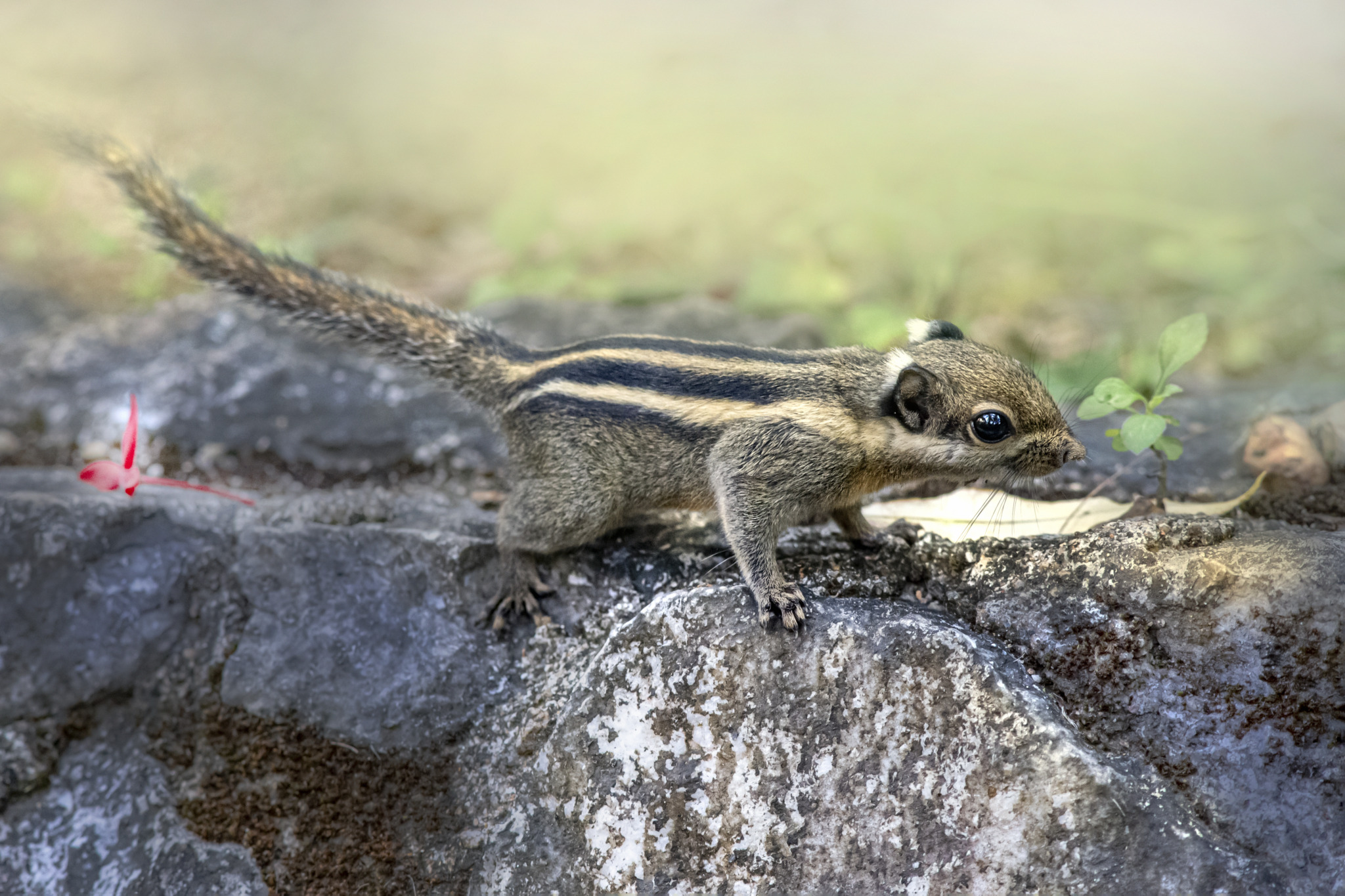

🐿️ Deep Review: Himalayan Striped Squirrel (Tamiops mcclellandii)
The Himalayan striped squirrel (also known as McClelland’s striped squirrel) is a small, energetic, and highly visual rodent. While it looks remarkably like a chipmunk, it is actually a true arboreal squirrel that spends its life darting through the canopies of South and Southeast Asia.
📏 Physical Characteristics
- The “Chipmunk” Illusion: This squirrel is often mistaken for a chipmunk due to its distinct dorsal stripes. It features three pale stripes and four dark stripes running down its back.
- Size: They are quite small and dainty compared to your average park squirrel.
- Body Length: ~10–16 cm.
- Tail Length: ~8–12 cm (often nearly as long as the body).
- Weight: Usually between 40 and 85 grams.
- Tail: Unlike the bushy tails of tree squirrels we see in the West, the Tamiops tail is relatively thin, though it ends in a slightly darker, more tufted tip.
- Coloration: Their base fur is usually a grizzled olive-brown or greyish-brown, which provides excellent camouflage against tree bark.
🌏 Habitat and Distribution
- Geographic Range: True to its name, it is found in the foothills of the Himalayas (Northeast India, Bhutan, Nepal) and extends throughout Myanmar, Thailand, Laos, Cambodia, Vietnam, and Southern China.
- Vertical Living: They are found from lowlands all the way up to montane forests at altitudes of 1,500 meters or higher.
- Adaptability: While they love tropical and subtropical moist broadleaf forests, they are surprisingly “urban-friendly.” You can often find them in gardens, parks, and plantations (especially coconut or fruit orchards) where they treat human-planted trees like their personal buffet.
🍎 Diet and Foraging
The Himalayan striped squirrel is an active omnivore. Because of its small size, it has a high metabolism and needs to find calorie-dense food quickly.
- Main Diet: Primarily fruits, seeds, and nuts.
- The “Sweet Tooth”: They are particularly fond of nectar and tree sap. You may see them licking the blossoms of tropical trees.
- Protein Boost: They regularly supplement their diet with insects (like cicadas and beetles) and have even been known to raid bird nests for eggs.
- Caching: Like most squirrels, they are diligent hoarders, hiding seeds in tree crevices to survive leaner periods.
🏃 Behavior and Social Life
- Diurnal Dynamite: They are strictly active during the day, with peaks in activity during the early morning and late afternoon.
- Arboreal Acrobatics: They are almost exclusively arboreal. They are incredibly fast and agile, moving with jerky, “robotic” bursts of speed that make them difficult for predators (like hawks or snakes) to track.
- Vocalizations: They are surprisingly chatty. They produce high-pitched “chirps” or “whistles” that can be easily mistaken for bird calls. These are used to mark territory or warn the colony of predators.
- Nesting: They don’t dig burrows. Instead, they build nests out of leaves and twigs in hollow tree trunks or high up in the forks of branches.
⚠️ Conservation Status
- IUCN Status: Least Concern.
- Population: They are currently widespread and common. Because they are adaptable to secondary forests (forests that have grown back after logging) and agricultural areas, they aren’t as threatened by human encroachment as more specialized species.
- Threats: Localized threats include habitat loss due to extreme deforestation and, in some areas, being hunted as small game or pests in orchards.
💡 The “Tamiops” vs. “Tamias” Distinction
It’s worth noting that while they look like the North American Chipmunk (Tamias), they belong to a completely different evolutionary branch.
Pro-Tip: If you see a “chipmunk” in a tree in Thailand or Vietnam, look at the tail. If it’s thin and the animal is acting like a caffeinated gymnast 30 feet in the air, you’re looking at a Tamiops squirrel.
Views: 1914
Subscribe to the newsletter: