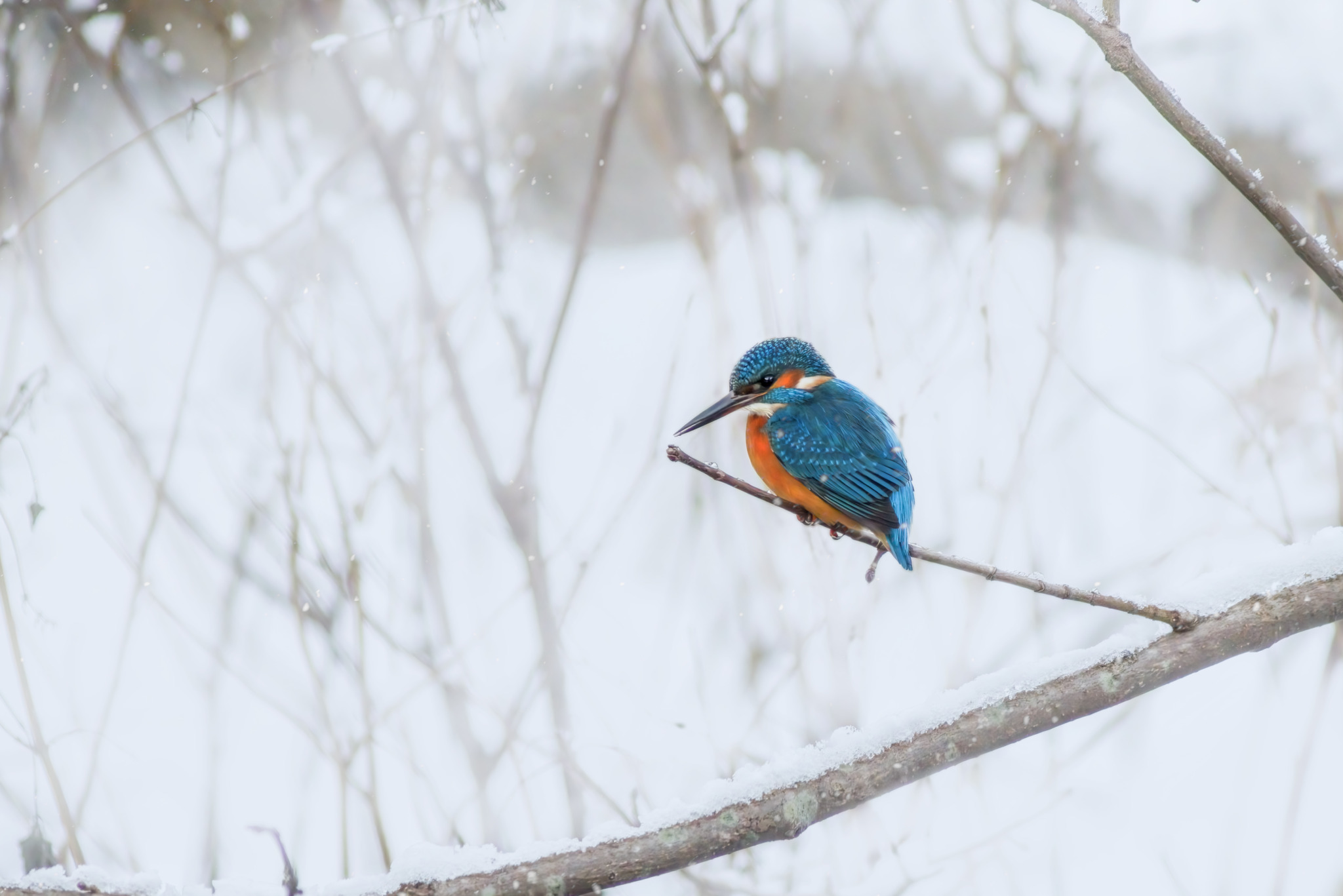
💎 Deep Review: Common Kingfisher (Alcedo atthis)
If you are walking by a quiet riverbank and catch a sudden, electric flash of cyan cutting through the air like a laser beam, you have just witnessed the Common Kingfisher. Often called the “flying jewel,” this small, hyper-specialized bird is a masterpiece of aerodynamic engineering and one of the most visually stunning birds in the old world.
📏 Physical Characteristics: The Electric Plumage
The Kingfisher’s colors are so intense they almost look artificial. Interestingly, the brilliant blue on its back isn’t caused by blue pigment, but by structural coloration—the microscopic structure of the feathers reflects light in a way that creates an iridescent sheen (Tyndall scattering).
- The Color Contrast: A cobalt/cyan blue back and head, paired with a rich, fiery copper-orange breast.
- The Silhouette: It has a highly distinct, compact shape: a large head, a short tail, stubby bright red legs, and a massive, dagger-like bill that looks slightly too big for its body.
- The “Lipstick” Trick (Sexing): Telling males and females apart is surprisingly easy if you look at the beak:
- Male: An entirely jet-black bill.
- Female: The base of her lower mandible (the bottom half of the beak) is bright orange-red. It looks exactly like she is wearing a swipe of lipstick.
| Feature | Measurement |
| Length | 16–17 cm |
| Wingspan | 24–26 cm |
| Weight | 34–46 grams |
| Flight Speed | Up to 40–50 km/h |
🚄 The Bullet Train Connection
The Common Kingfisher is a master of fluid dynamics. When it dives into the water, its long, wedge-shaped beak allows it to break the surface tension seamlessly, creating almost zero splash.
Biomimicry Fact: In the late 1990s, Japanese engineers designing the iconic Shinkansen (Bullet Train) faced a massive problem: when the train exited tunnels at high speeds, it created a loud atmospheric sonic boom that disturbed residential areas. The chief engineer, an avid birdwatcher, modeled the nose of the next-generation train after the beak of the Common Kingfisher. The redesign not only eliminated the noise but made the train 10% faster and 15% more energy-efficient.
🏹 Hunting: The Perfect Strike
Kingfishers are strict visual predators that rely on a highly effective “perch-and-dive” method.
- The Scan: The bird sits motionless on a low-hanging branch over clear, slow-moving water, bobbing its head up and down to gauge the exact depth of a fish (compensating for light refraction).
- The Dive: It launches downward, pinning its wings against its body to become a living torpedo.
- The Blind Strike: The moment it enters the water, a translucent third eyelid (the nictitating membrane) closes over its eyes. This protects the eyes but means the kingfisher is flying completely blind under the surface—it relies entirely on the accuracy of its initial calculation.
- The Tenderizer: It grabs the fish, bursts backward out of the water, and returns to its perch. Because fish have sharp spines, the kingfisher will violently whack the fish against the branch several times to stun or kill it and break its bones before swallowing it head-first.
🏠 Home Life: The Fish-Bone Tunnel
Kingfishers don’t build nests in trees. Instead, they are burrowers.
- The Excavation: Using their beaks like pickaxes, a mated pair will dig a horizontal tunnel into a vertical, sandy riverbank. The tunnel can be up to a meter long and ends in a rounded nesting chamber.
- The “Decor”: Over time, the nesting chamber becomes lined with a layer of regurgitated fish bones and scales, which acts as a crude, crunchy mattress for the eggs.
- High Turnover: Right now in mid-May, kingfisher pairs are in the thick of their breeding season. They are incredibly industrious and can raise 2 to 3 broods a year, meaning the parents are constantly under pressure to catch hundreds of fish a week.
⚠️ Conservation and Water Quality
- IUCN Status: Least Concern.
- The Vulnerability: While they are widespread across Europe, Asia, and North Africa, they are highly sensitive indicators of environmental health.
- Clean Water is Life: A kingfisher cannot hunt in polluted, murky, or algae-choked water because it cannot see its prey. Habitat destruction, riverbank concreting (which eliminates nesting sites), and severe winter freezes (which lock them out of their hunting grounds) are their greatest threats.
Views: 1497
Subscribe to the newsletter: