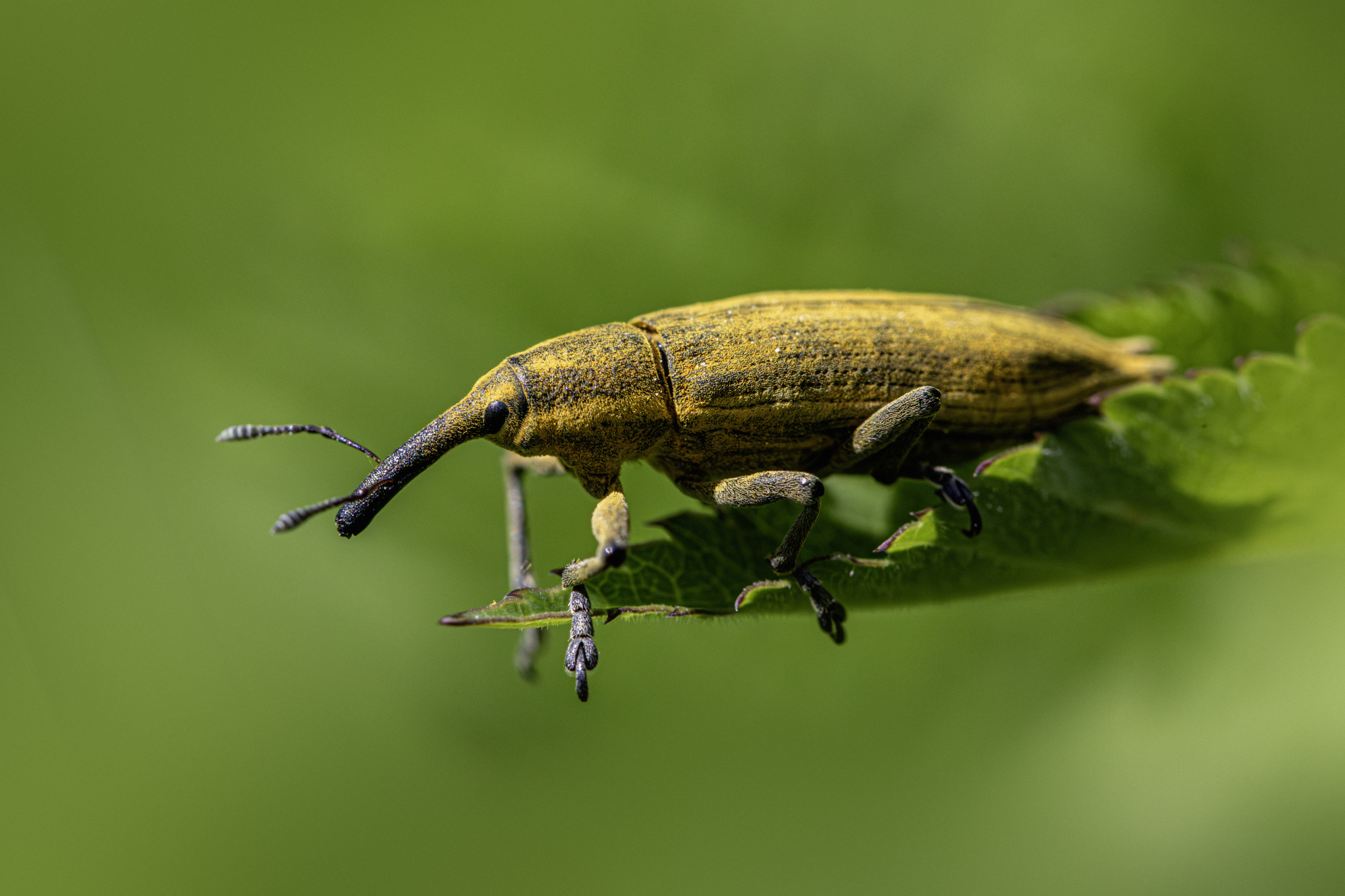
🌿 Deep Review: Lixus iridis (The Iris Weevil)
While many of the insects we’ve discussed are widely known, Lixus iridis is a fascinating “specialist.” It belongs to the Curculionidae (true weevil) family and is one of the larger, more elegant members of the group. If you spend time near wetlands or riverbanks in Estonia during the summer, you might spot this master of mimicry.
📏 Physical Characteristics: The Slender Architect
- Distinctive Shape: Unlike the stout, round Nettle Weevil, Lixus iridis is incredibly long and slender, often described as “cylindrical.” Its body is elongated to mimic the stems of the plants it lives on.
- Coloration: It is typically a dusty, muted grey-green or olive, often covered in a fine, powdery, yellowish or whitish bloom (a waxy secretion). This coating acts as both protection against the elements and as excellent camouflage against the stems of its host plants.
- The Snout: It possesses a long, slender rostrum (snout) that is slightly curved, which it uses to probe deeply into plant tissues for feeding or to prepare sites for egg-laying.
- Size: They are relatively large for weevils, typically reaching 12–18 mm in length.
🥗 Diet: The Specialist of the Asteraceae
As its name implies, Lixus iridis is closely linked to specific plant hosts, though its name is a bit of a misnomer. While the name suggests an association with Irises (Iris), it is actually most commonly found on various species in the Asteraceae (daisy) family.
- Host Plants: You will most frequently find them on plants like Thistles (Cirsium and Carduus species), Salsify (Tragopogon), and Leontodon.
- Life Cycle:
- Feeding: Adults feed on the stems and leaves, often creating longitudinal feeding scars.
- Egg-Laying: The female uses her snout to drill a hole into the stem of the host plant, where she deposits her eggs.
- Larval Development: The larvae are stem-borers. They hatch inside the plant stem and feed on the internal tissues, which can cause the stem to swell or form a gall-like structure. They eventually pupate inside the stem before emerging as adults.
🌍 Habitat and Distribution
- Environment: They thrive in “open, sunny habitats” where their host plants are plentiful. Think road verges, meadow edges, damp grassland, and riverbanks.
- Distribution: They are widespread across Europe and into Western Asia. In Estonia, they are present but considered a more localized species because they require specific host plants that aren’t as omnipresent as the Stinging Nettle.
- Seasonality: Right now, in mid-July, is the perfect time to find them. They are active from late spring through to the end of the summer.
🛡️ Defensive Strategy: The “Stick” Impression
- Mimicry: Lixus iridis is a master of “crypsis.” When it sits perfectly still on the stem of a tall thistle or salsify, it is almost impossible to distinguish from a natural protrusion or a bud on the plant.
- The Drop: Like its cousin the Nettle Weevil, it uses the “drop” technique when threatened. However, because it is so slender and long, when it falls into the dense vegetation below, it looks like a small twig or piece of dried plant stem, allowing it to vanish in plain sight.
⚠️ Conservation and Human Interaction
- Status: Not threatened.
- Agricultural Impact: Because they primarily target wild thistles and related weeds, they are generally not considered pests in agricultural contexts. In some research circles, Lixus species have even been studied as potential biological control agents to help manage invasive thistle populations.
Observation Tip for July: If you are walking through a meadow with tall thistles, look for small, longitudinal holes or “craters” in the stems. If you see one, look carefully at the stem just above or below the hole—the Lixus iridis is likely sitting there, perfectly camouflaged, hoping you’ll walk right past it.
Views: 199
Subscribe to the newsletter: