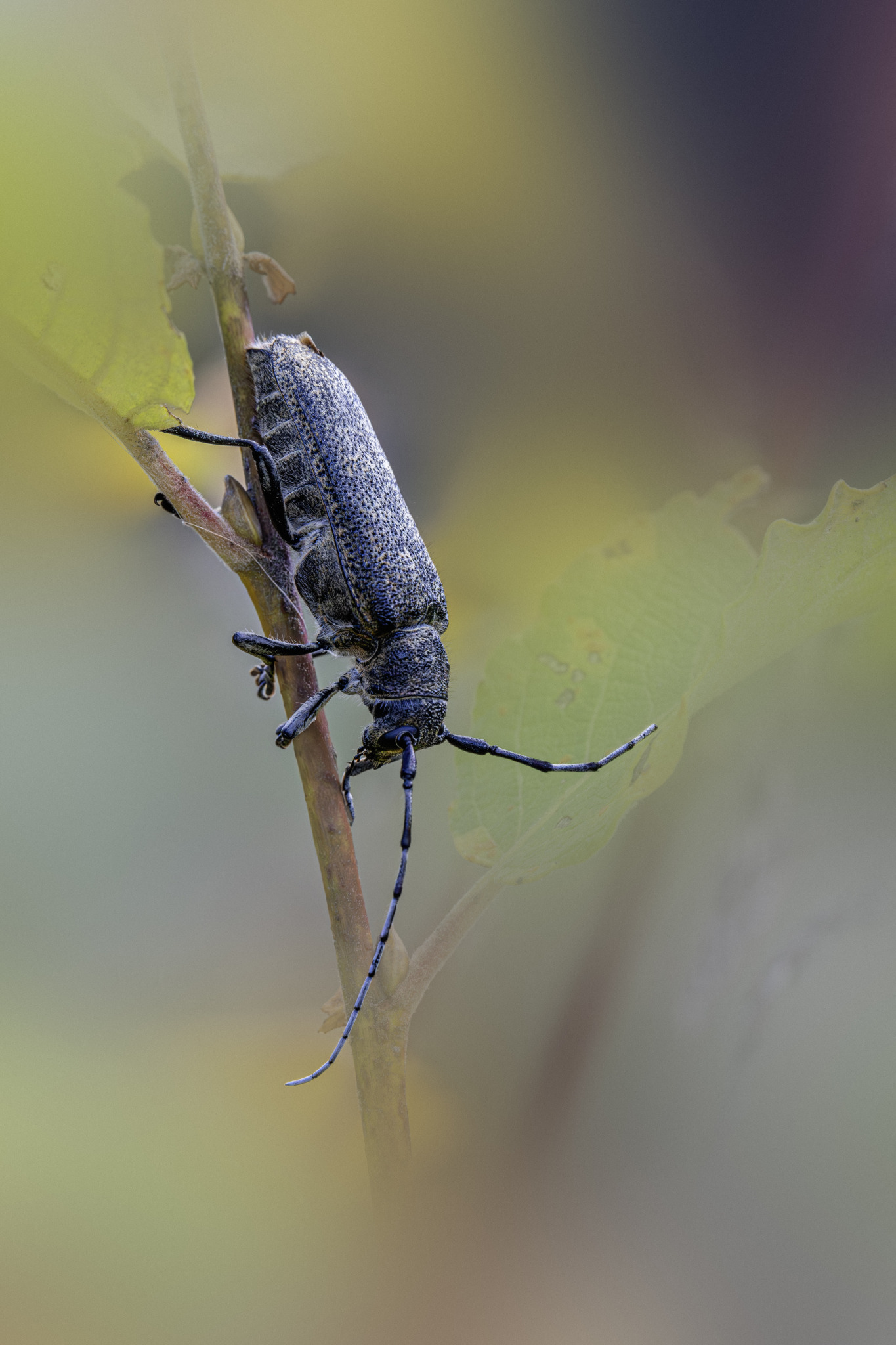
🪲 Deep Review: Large Poplar Borer / Longhorn Beetle (Saperda carcharias)
If you happen to wander near a damp woodland edge, poplar grove, or river basin in late summer, you might encounter a true gentle giant of the beetle world: the Large Poplar Borer (Saperda carcharias). As one of the largest members of the longhorn beetle family (Cerambycidae) in Europe, this impressive insect is an engineering marvel of the tree canopy, though its life cycle makes it a notorious figure in forestry.
📏 Physical Characteristics: The Armored Titan
The Large Poplar Borer is built for power and camouflage, featuring several distinctive traits that make it unmistakable.
- Size: This is a substantial beetle, with adults typically measuring between 20 and 30 mm (2 to 3 cm) in length, excluding their exceptionally long antennae.
- The Coat: Its entire body is covered in a dense, velvety layer of brownish-grey or yellowish-grey pubescence (fine hairs), dotted with numerous small, dark black punctures. This gives it a textured, dusty appearance that mimics the rough bark of a poplar trunk.
- The Antennae: As a longhorn beetle (Cerambycidae), it features long, segmented antennae that sweep backward over its body. In males, these antennae can be noticeably longer than the body itself.
- The Shape: It has a robust, cylindrical body with a broad thorax equipped with small lateral spines.
🪵 The Multi-Year Larval Life Cycle
While adult beetles lead a relatively brief, sunny life feeding on leaves, the hidden larval stage is an epic saga of timber excavation.
- Egg-Laying: In mid-summer, the female uses her strong mandibles to chew a small, crescent-shaped slit into the bark of a living poplar or willow tree (typically targeting weakened, stressed, or young trees). She deposits a single egg beneath the bark.
- The Wood-Borning Grub: Once hatched, the legless, yellowish larva burrows deep into the sapwood and heartwood. It spends two to three years tunneling extensively inside the trunk, chewing through dense wood and creating large, ascending galleries packed with wood-dust and frass.
- Pupa Stage: After reaching full size (often growing up to 40 mm long), the larva prepares a pupal chamber near the surface, emerges as an adult, and chews a neat, round exit hole to step out into the world.
🥗 Diet: Leaves for Adults, Timber for Grubs
- Adult Diet: Adults are active from June through September. You can find them resting on the leaves and bark of poplars (Populus species—especially Aspen and Black Poplar) and occasionally willows. They feed on the leaf veins, young shoots, and bark, though their feeding damage is usually minor compared to the work of the larvae.
- Larval Diet: Strictly xylophagous (wood-eating), consuming the internal structural tissues of living host trees.
🌍 Habitat and Distribution
- Environment: Found across woodlands, river valleys, shelterbelts, forest edges, and parks wherever poplars and willows are established.
- Range: Widespread throughout the Palearctic realm—spanning across Europe, Central Asia, and eastward to Siberia.
- Seasonality: Right now, in September 2026, you are seeing the tail end of the adult flight season as they finish mating, lay their final eggs of the year, and prepare for the changing autumn.
⚠️ Forestry Perspective: Pest or Native Resident?
- Commercial Impact: Because the larvae bore deep holes into the trunks of living trees, they can structurally weaken timber, introduce fungal infections, and cause young trees to snap in strong winds. In commercial poplar plantations, Saperda carcharias is considered a significant timber pest.
- Ecological Role: In natural, wild forest ecosystems, however, the damage they cause creates essential microhabitats. Their abandoned galleries and stressed trees provide nesting sites, shelter, and food for various cavity-nesting birds, fungi, and other secondary invertebrates.
Field Tip: If you are walking through a grove of aspens or poplars late in the summer, look closely at the lower trunks. If you see circular exit holes the size of a pencil eraser, or notice fine, sawdust-like frass pushed out from cracks in the bark, you’re looking at the signature of the Large Poplar Borer. With a bit of luck, you might spot the heavy, grey-brown beetle itself resting motionlessly against the bark, blending in completely!
Views: 198
Subscribe to the newsletter: