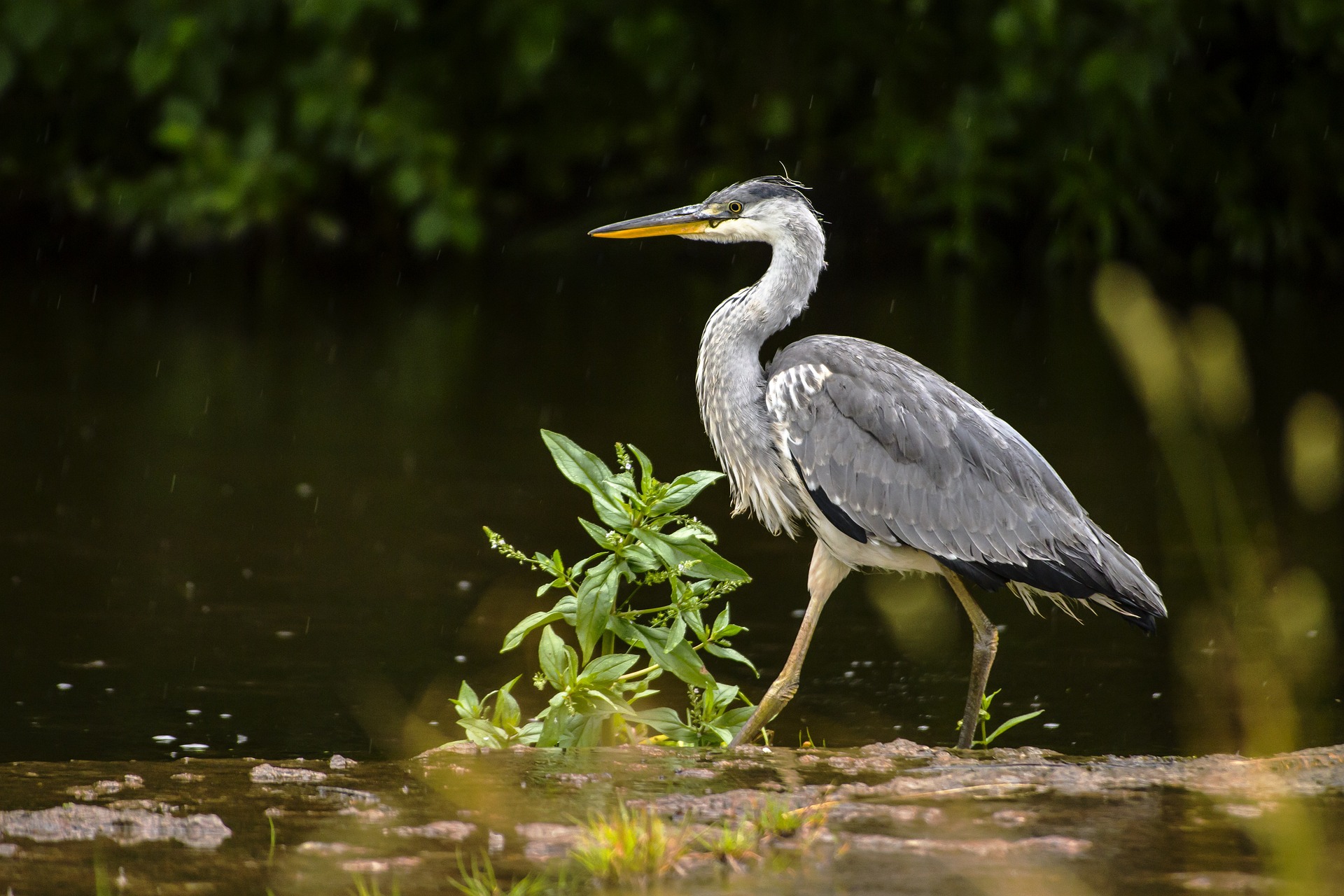
🐦 Deep Review: Grey Heron (Ardea cinerea)
If you’ve ever looked out over a misty lake and thought you saw a living pterodactyl, you were likely looking at a Grey Heron. Standing tall and motionless at the water’s edge, this large wading bird is the apex patient predator of the old world’s wetlands. It is highly adaptable, incredibly striking, and a master of the slow-motion hunt.
📏 Physical Characteristics: The Prehistoric Profile
The Grey Heron is an imposing bird with a lean, heavily engineered body designed entirely for wading and striking.
- Coloration: True to its name, its upperparts are a sleek slate-grey, while its underparts are an off-white. Adults sport a distinctive black stripe over each eye that extends backward into a few long, elegant crest plumes.
- The Weapon: Its beak is a massive, dagger-like tool that is dull yellow-orange most of the year but turns a bright, fiery orange during the peak of the breeding season.
- The S-Neck: It has an incredibly long neck with modified vertebrae that allow it to fold tightly into an “S” shape and snap forward like a spring-loaded spear.
| Feature | Measurement |
| Height | 90–100 cm (nearly 3.3 feet) |
| Wingspan | 175–195 cm (a massive, broad reach) |
| Weight | 1.0–2.1 kg (surprisingly light due to hollow bones) |
| Lifespan | 5–15 years in the wild |
✈️ The Flight Silhouette
Identifying a Grey Heron in the air is simple once you know what to look for. Unlike storks, cranes, or flamingos—which fly with their necks stretched out straight—the Grey Heron retracts its neck completely into its shoulders while flying.
Its flight is slow and deliberate, characterized by deep, bowed wingbeats, with its long legs trailing straight out far behind its tail.
🏹 Hunting Style: The Patient Assassin
The Grey Heron is the personification of “stealth wealth” when it comes to energy conservation. It uses two primary hunting methods:
- The Statue: It stands perfectly still in shallow water or on a bank, sometimes for hours, waiting for prey to swim or crawl within range.
- The Slow Stride: It moves through the water with agonizingly slow, calculated steps, lifting each foot silently to avoid creating ripples that might alert its prey.
When an target is acquired, the heron’s neck straightens with terrifying speed. It can either snap its beak closed around smaller prey or completely impale larger fish with a downward thrust.
🐟 A Surprisingly Brutal Diet
While they are classified as waterbirds, Grey Herons are highly opportunistic carnivores that will eat anything they can swallow whole.
- Wetland Menu: Fish (from tiny minnows to large eels), frogs, newts, and crabs.
- Terrestrial Menu: They regularly hunt in dry fields for voles, mice, and moles.
- The Dark Side: They are aggressive predators of other birds. It is not uncommon to see a Grey Heron snatch up ducklings, moorhen chicks, or even full-grown water rats and swallow them alive. If the prey is too large or furry, they will carry it to the water to drown it and lubricate it before swallowing.
🏠 Social Life: The Noisy Heronry
While they hunt in solitary silence, Grey Herons are highly social when it comes to family planning.
- The Heronry: They nest in colonies called heronries, often high up in the canopy of mature trees near waterbodies (though they will nest on cliff faces or reedbeds if trees are unavailable).
- The Nest: A massive, chaotic platform of sticks that grows larger year after year as pairs return to the same spot.
- The Din: If you walk under a heronry in spring, the noise is deafening. They communicate with harsh, guttural croaks, squawks, and bill-snapping that sounds less like a bird and more like a colony of barking reptiles.
⚠️ Conservation and the “Garden Conflict”
- IUCN Status: Least Concern. Populations are stable and thriving across Europe, Asia, and parts of Africa.
- The Goldfish Thief (The Candor Part): Because they are highly adaptable, Grey Herons have figured out that suburban neighborhoods are filled with small, unprotected, brightly-colored buffets—otherwise known as garden koi ponds.
- Prevention: If a heron is raiding your pond, standard scarecrows won’t work for long; they are too smart. The only truly effective deterrents are physical pond netting, a plastic decoy heron (as they are territorial and will often avoid a pond that looks “occupied”), or wires strung around the perimeter of the pond to prevent them from landing and walking in.
Views: 1533
Subscribe to the newsletter: