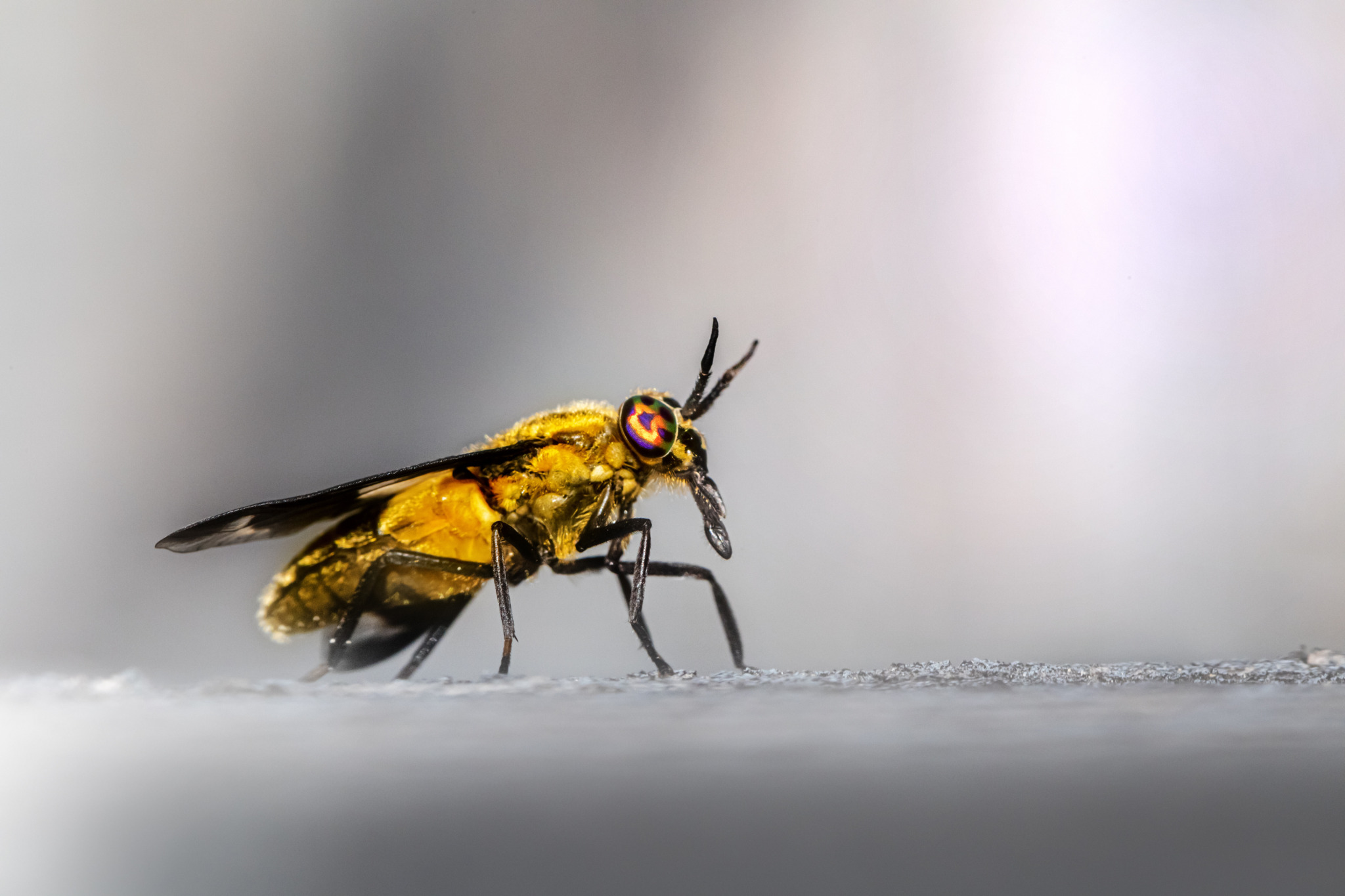

🪰 Deep Review: Splayed Deer Fly (Chrysops caecutiens)
If you’ve ever been enjoying a summer walk through a damp forest only to be targeted by a persistent insect that circles your head like a heat-seeking missile, you’ve likely met the splayed deer fly. Also known colloquially in some regions as the Scotch cleg, this member of the Tabanidae (horse-fly) family is a paradox of nature: breathtakingly beautiful to look at under a magnifying glass, but an absolute menace in the field.
📏 Physical Characteristics: The Psychedelic Prowler
At roughly the size of a standard housefly, the splayed deer fly stands out due to its incredibly high-contrast, almost psychedelic wardrobe.
- The Techno-Eyes: Their most spectacular feature is their massive compound eyes. They shimmer with vibrant, iridescent red, green, and purple reflections, broken up by dark, zigzagging spots.
- The “Splayed” Marking: Its common name comes from the distinct, dark inverted-V or twin-lobed marking on the second segment of its otherwise yellow-and-black abdomen. It looks a bit like a pair of splayed wings painted onto its back.
- The Banded Wings: Unlike common flies with clear wings, Chrysops caecutiens has striking dark brown patches across its translucent wings. When at rest, they hold these wings open in a characteristic delta shape.
📊 Comparison: Female vs. Male
| Feature | Female | Male |
| Diet | Hematophagous (Requires blood for egg development). | Strictly vegetarian (Feeds on nectar and pollen). |
| Abdomen | Bright yellow patches with the black inverted-V. | Almost entirely black or very dark. |
| Eyes | Divided by a small gap on the forehead. | Join together completely at the top of the head. |
| Mouthparts | Fully functional slashing blades. | Weakened, incapable of piercing skin. |
🏹 Behavior: The Stealth Head-Hunter
Deer flies don’t behave like standard mosquitoes or houseflies. They have a highly specific tactical playbook:
- The Target Zone: They are notoriously drawn to motion, dark colors, and carbon dioxide. They almost always target the head, neck, and shoulders of humans and large mammals (like roe deer and cattle).
- The Silent Approach: Unlike horseflies, which often herald their arrival with a loud, heavy buzz, deer flies are incredibly stealthy. They fly silently and often land so softly on your hair or the back of your neck that you won’t realize they are there until you feel the bite.
- Visual Hunters: The complex structure of the female’s eyes allows her to utilize high light polarization, helping her track the silhouettes of moving hosts against dense, shaded foliage.
🌍 Habitat and “Muck” Life
- Range: Widespread across Europe, the eastern Palearctic realm, and the Near East. They are active during the warmest months, peaking from late June to late July.
- The Damp Preference: You are highly unlikely to encounter them in dry, open fields. They love shaded marshlands, damp woodlands, peat bogs, and the muddy edges of slow-moving streams.
- The Predatory Larvae: While adult males happily sip nectar from oxeye daisies, the larvae are subterranean hunters. They live in wet mud and silt, feeding aggressively on organic matter and other small invertebrates.
⚠️ Medical Significance (The Candor Part)
Let’s be direct: a bite from a female Chrysops caecutiens is not something you easily forget.
- The Slashing Mouthparts: Mosquitoes use a neat, needle-like probe to elegantly sip blood. Deer flies do not. They possess tiny, scissor-like mouthparts designed to slash open the skin to create a small pool of blood, which they then lap up.
- The Anticoagulant: As they feed, they inject saliva packed with an anti-coagulating agent to keep the blood from clotting. This saliva is what causes the intense localized itching, swelling, and sometimes painful, persistent welts that follow.
Defense Tip: Because deer flies hunt visually and love dark colors, wearing light-colored clothing (like whites or light beige) can significantly reduce your chances of being targeted. Physical barriers—like a wide-brimmed hat or a head net in heavily infested woods—are your best line of defense, as chemical repellents like DEET have mixed success against their hyper-focused visual targeting.
Views: 1623
Subscribe to the newsletter: