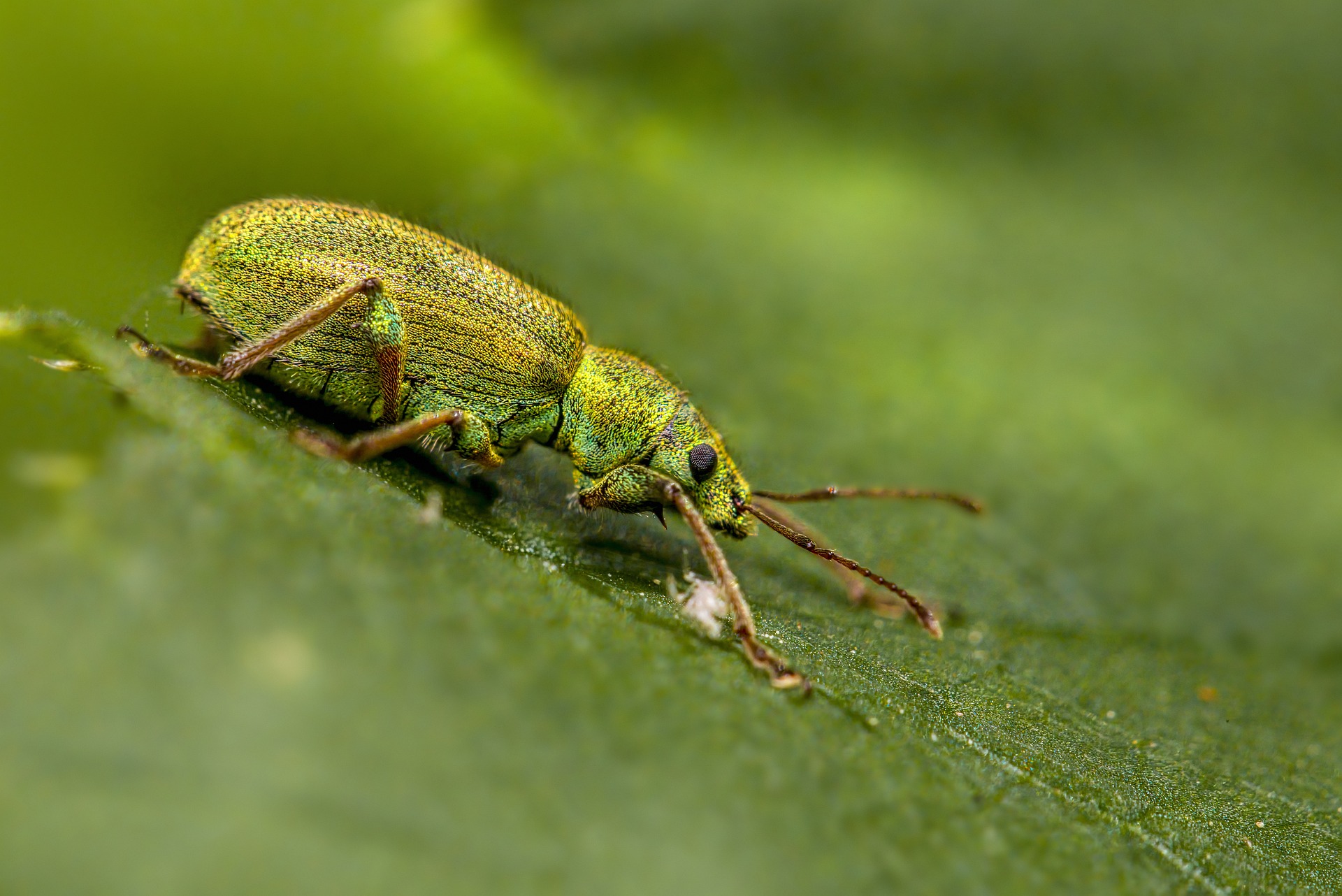
🟢 Deep Review: Nettle Weevil (Phyllobius pomaceus)
The Nettle Weevil, or Green Nettle Weevil, is arguably one of the most beautiful “pests” you will ever encounter. With an exoskeleton that looks like it has been dusted with crushed emeralds or polished metallic lime, it is a stunning piece of biological jewelry.
📏 Physical Characteristics: The Living Gem
- Metallic Lustre: Their body is covered in tiny, overlapping scales. These scales are highly reflective and responsible for the vivid, metallic green, gold, or copper-like sheen. If you find one in an old, dry collection, you might notice it looks duller—that’s because the scales wear off or lose their structural color over time.
- The “Snout”: Like all members of the Curculionidae (weevil) family, they have a characteristic elongated snout (rostrum). However, compared to other weevils, this one is relatively short and thick.
- Size: They are small, typically measuring between 8 and 12 mm.
🥗 Diet and The “Nettle Connection”
As the name implies, this weevil has an incredibly specialized relationship with the Stinging Nettle (Urtica dioica).
- Adults: You will almost exclusively find them on stinging nettle plants, where they feed on the leaves. They create a distinctive, semi-circular “scalloped” edge on the leaves, which is a classic sign of weevil grazing.
- Larvae: The life of the larva is much more cryptic. The female lays her eggs in the soil near the base of the plant. Once hatched, the larvae burrow into the earth to feed on the roots of the nettle.
🌍 Habitat and Distribution
- Range: Very common across most of Europe and parts of temperate Asia.
- Where to find them: They are everywhere you find a patch of nettles—woodland edges, shaded lanes, garden boundaries, and hedgerows.
- Seasonality: Right now, in late May 2026, is prime time. They are most active from late spring through the height of summer, reaching their peak in June.
🛡️ Defensive Strategy: The “Drop”
If you reach out to touch a Nettle Weevil, you’ll rarely succeed. They have a very effective escape mechanism: thanatosis (feigning death).
- The Drop: When the weevil senses vibration or movement (which its antennae are incredibly sensitive to), it immediately stops feeding and tucks its legs tightly against its body. It then simply lets go, dropping from the leaf into the dense, tangled base of the nettle patch.
- The Disappear: Once it hits the ground, it blends perfectly with the soil and debris. Because nettle patches are usually thick and prickly, it is nearly impossible for a predator (or a human photographer) to follow it down.
📊 Are they a Pest?
While they feed on plants, they are rarely considered a threat to human interests:
- Beneficial Context: Because they stick so strictly to Stinging Nettles—a plant that is incredibly prolific and often considered a “weed”—they cause zero damage to cultivated crops, flowers, or vegetable gardens.
- Ecological Role: They act as natural controllers of nettle spread. By grazing on the foliage and, more importantly, by having larvae that feed on the roots, they help keep massive, invasive nettle patches in check.
Pro-Tip for 2026 Observers: If you want to see these up close, don’t walk up to a patch and stare. Approach slowly, hold a white sheet or a piece of paper underneath a group of leaves, and gently shake the plant. The weevils will “play dead” and fall onto your sheet, where you can admire their incredible, jewel-like coloration without the risk of being stung by the nettle!
Views: 1733
Subscribe to the newsletter: