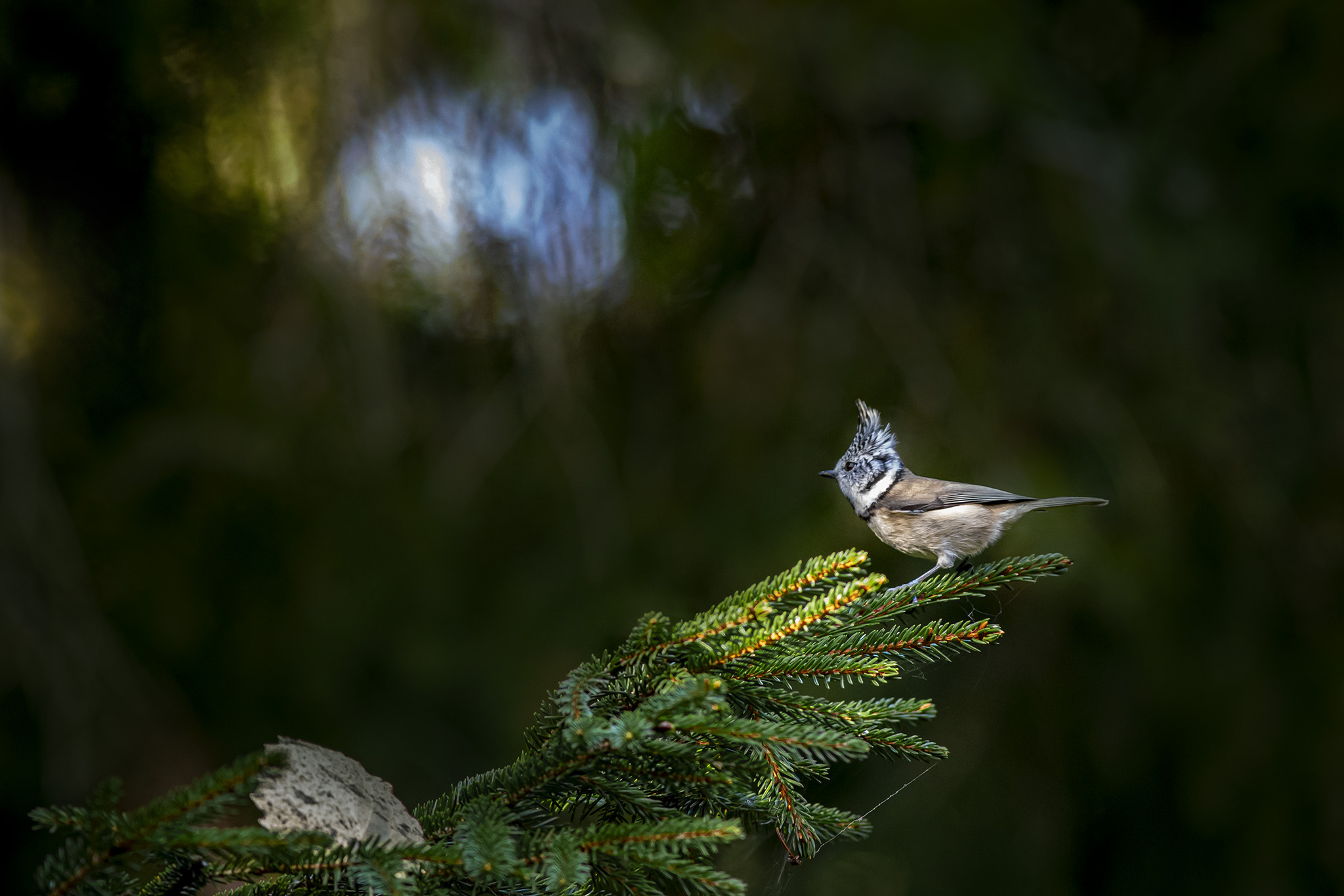

🌲 Deep Review: European Crested Tit (Lophophanes cristatus)
If you are walking through an ancient, quiet pine forest in northern or central Europe, one of the most distinctive and charming sounds you can hear is a dry, rattling trill high up in the canopy. Look up, and you will likely spot one of the most visually unmistakable woodland residents: the European Crested Tit (Lophophanes cristatus).
Formerly grouped in the massive Parus genus, this species (along with several close relatives) now resides in Lophophanes, celebrated for its punk-rock crest and exceptional survival skills in harsh evergreen woods.
📏 Physical Characteristics: The Punk-Rock Tit
The Crested Tit is instantly recognizable and completely unique among European tits.
- The Crest: Its defining feature is a prominent, pointed, forward-curving crest made of black-and-white speckled feathers. When the bird is excited, alert, or displaying, the crest stands erect like a miniature helmet or punk-rock spike.
- Facial Pattern: It features a striking, bold black-and-white facial mask, including a distinct black collar, a black throat patch (bib), and a dark line curving down from behind the eye (looking like a tiny drawn mustache).
- Body: Soft, warm greyish-brown upperparts and pale, buff-white underparts.
- Size: A tiny, compact bird, measuring just 10.5 to 11.5 cm in length with a weight of around 10 to 13 grams.
🌲 Habitat: The Coniferous Specialist
Unlike the Great Tit or Blue Tit, which are happy to live in deciduous broadleaf forests, city parks, and suburban gardens, the Crested Tit is a dedicated taiga and conifer forest specialist.
- Forest Types: It favors dense stands of mature pine, spruce, and fir.
- Distribution: Widely distributed across northern and central Europe (with major strongholds in Scandinavia, the Baltic region including Estonia, and mountain ranges like the Alps), though completely absent from the UK and Ireland.
- Year-Round Resident: They are strictly sedentary birds. They do not migrate; a Crested Tit will typically spend its entire life within a few kilometers of where it hatched, enduring deep winter snows and freezing temperatures without ever leaving the evergreens.
🧠 Diet and Behavioral Adaptations
Life in a cold pine forest year-round requires serious logistical planning.
- The Menu: In spring and summer, they glean insects, spiders, and caterpillars from the bark and needles of conifers. In autumn and winter, they shift to conifer seeds (especially pine seeds), hammering open cones with their stout little bills.
- Caching Master (Hoarding): Because winter food is scarce, Crested Tits practice food-hoarding. Throughout the late summer and autumn, they hide thousands of individual seeds and insects under loose pieces of tree bark, in lichen clumps, or among pine needles.
- The Memory: They possess an exceptional spatial memory, allowing them to return to these hidden caches weeks or months later, even when they are buried under layers of fresh snow.
🐣 Breeding and Nesting
- The Excavator: Unlike many tits that readily move into wooden nestboxes, Crested Tits prefer to excavate their own nesting cavities. Using their bills, they carve out a home inside a decaying pine stump, a rotten birch snag, or occasionally an old woodpecker hole.
- Timing: They breed relatively early in the spring (April to May), laying a clutch of 5 to 8 speckled eggs that are incubated strictly by the female while the male feeds her.
🛡️ Conservation Status
- IUCN Status:Least Concern.
- The Forest Management Challenge: Because they rely heavily on rotting wood for nesting and mature conifer trees for feeding and hoarding, intensive modern forestry practices that clear out dead snags and replace ancient mixed forests with uniform commercial pine plantations can negatively impact local populations.
Field Tip: If you are exploring a pine forest in Estonia or northern Europe, listen for a dry, rattling churr-churr-churr combined with a high-pitched, piping note. If you stand quietly near a tall pine, a little feathered knight with a spiky black-and-white crown will often pop into view, hopping fearlessly along the branches just meters above your head!
Views: 1325
Subscribe to the newsletter: